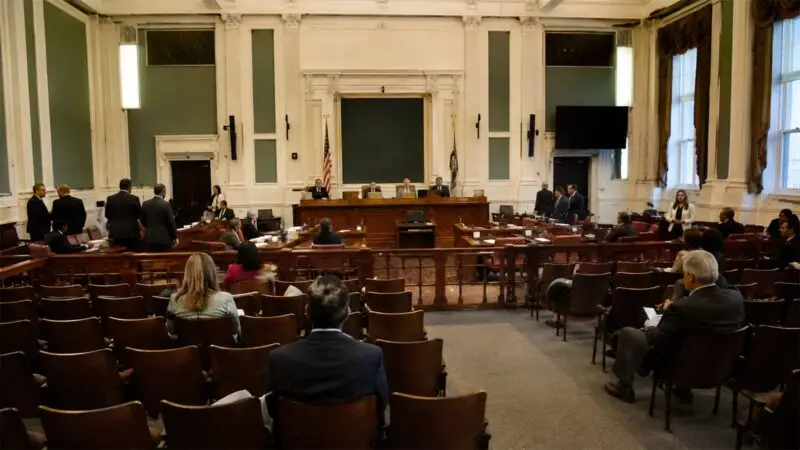


The National Assembly has voted to abolish undergraduate tuition fees at Coravia’s twelve public universities from the autumn of 2027, passing the Higher Education Access Act by 214 votes to 96 at the end of an overnight sitting that stretched to nearly fourteen hours.
The act replaces fee income with a direct public funding settlement worth $3.1bn a year, indexed to enrolment and inflation, and creates a national maintenance grant for students from households earning below the national median. Fees at public universities currently average $4,800 a year and have tripled since 2007.
Education Minister Halda Rennick, who steered the bill through three fractious readings, told a packed chamber that the reform would “settle a debt this country has quietly loaded onto its youngest citizens for a generation”.
The opposition Concord Party backed the bill’s central promise while attacking its financing. “A promise written in pencil is not a promise,” said its leader, Casmir Reyle, urging the government to guarantee the settlement in the autumn budget rather than in “a minister’s speech”.
“No talented young Coravian should ever again have to weigh a degree against a decade of debt.”
Halda Rennick, Education Minister
The government intends to fund the scheme through a graduated training levy on employers with more than 250 staff, alongside the closure of two corporate tax reliefs that the Finance Ministry values at $1.4bn a year. The independent Fiscal Council said last month that the plan was “credible but tightly drawn”, warning that a downturn in levy receipts would leave “little room for error”.
University leaders welcomed the vote while pressing for detail. Professor Adela Vantris, vice-chancellor of the University of Meridale, said the settlement “must rise with real costs, not with headlines”, noting that laboratory-based degrees already run at a deficit under the current fee cap.
Student groups celebrated outside the Assembly through the early hours. “This is the first budget line in living memory written for people who haven’t graduated yet,” said Ivo Marek, president of the National Student Assembly, which has campaigned for abolition since 2019.
The reform arrives in phases. Students beginning courses in autumn 2027 will pay no fees from their first term; continuing students will see fees erased from 2028; and by 2029 the last fee-paying cohort will graduate. Part-time and mature students are covered on the same terms, a late amendment won by a cross-party group of backbenchers. Fees for international students, which are set by institutions, are unchanged.
What happens next
An implementation council chaired by the higher-education regulator will publish the funding formula in October, with the first maintenance grants paid in September 2027. The Education Ministry must also report annually on capacity, after modelling suggested applications could rise by up to 12 per cent in the first two years.
For Prime Minister Elna Vosker, whose coalition has trailed in polling since the spring, the act is the centrepiece of a legislative season that also produced the $9bn Coastal Shield infrastructure programme. The Assembly rises for its summer recess on Friday; the fee regulations return for technical approval in the autumn session — the moment, as one minister put it on the chamber steps this morning, “when the applause stops and the arithmetic starts”.